Grindr Xtra currently costs $29.99 per month, while the Unlimited tier is priced at $54.99 per month. Annual subscriptions typically offer a 30-40% discount but require a significant upfront commitment.
As of May 2026, the 3D face scan is required to receive a 'Verified' badge. While you can use the app without it, many users now filter their grids to only show verified profiles to avoid bots.
By default, Grindr shows your distance. While you can hide your distance in the settings, your profile still appears in a sequence based on proximity, meaning 'triangulation' is still possible for tech-savvy users.
Grindr is a hyper-local, real-time social ecosystem for the GBTQ+ community. The platform serves as an essential utility for immediacy, helping users find hookups, last-minute drinks, local travel advice, or community connections. It prioritizes direct interaction through a proximity-based grid sorted by distance.
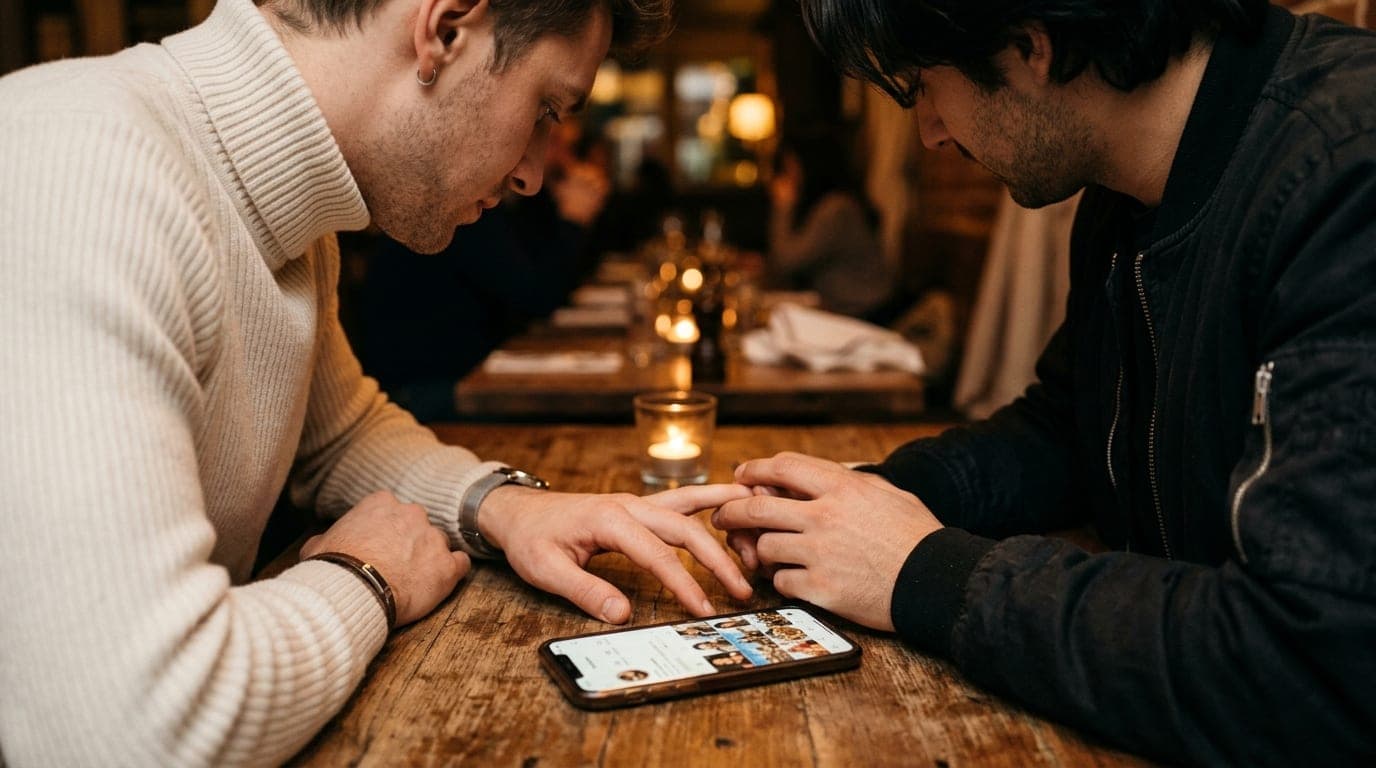
The Grindr app functions as a real-time grid of user profiles sorted by GPS distance. When users open the app, they immediately see nearby profile photos and can instantly send messages, share taps, or use precise location sorting to connect with local community members right away.
After nearly two decades of dominance, Grindr remains the undisputed king of the hill, though the hill is increasingly made of recycled plastic and intrusive tracking pixels. As of May 2026, the app feels less like a revolutionary social tool and more like a legacy utility—the digital equivalent of a municipal bus station: essential, crowded, slightly grimy, and arguably the only way to get where you’re going if you don’t have a private car. This year’s updates have leaned heavily into AI-driven verification and a "Social Hub" that tries to mimic Instagram, with varying degrees of success. However, the core experience remains unchanged: a proximity-based grid of faces (and torsos) that offers the fastest path to a connection in the queer world, provided you have the mental fortitude to navigate the chaos. It is a tool of pure efficiency, stripped of the romantic pretension of Hinge but burdened by a monetization strategy that has become increasingly hostile to the average user. Overall Rating: 5.8/10
After nearly two decades of dominance, Grindr remains the undisputed king of the hill, though the hill is increasingly made of recycled plastic and intrusive tracking pixels. In April 2026, the app feels less like a revolutionary social tool and more like a legacy utility—the digital equivalent of a municipal bus station: essential, crowded, slightly grimy, and arguably the only way to get where you’re going if you don’t have a private car. This year’s updates have leaned heavily into AI-driven verification and a "Social Hub" that tries to mimic Instagram, with varying degrees of success. However, the core experience remains unchanged: a proximity-based grid of faces (and torsos) that offers the fastest path to a connection in the queer world, provided you have the mental fortitude to navigate the chaos. It is a tool of pure efficiency, stripped of the romantic pretension of Hinge but burdened by a monetization strategy that has become increasingly hostile to the average user. Overall Rating: 5.8/10
Sponsored Content
What grindr Is and Who It's For
By 2026, the "dating app" label feels like a misnomer for Grindr. It is a hyper-local, real-time social ecosystem for the GBTQ+ community. While competitors like Hinge or Archer have successfully carved out the "relationship-minded" demographic, Grindr remains the default for everything else: hookups, last-minute drinks, travel advice, and the occasional "Looking for a gym partner" post that everyone knows is code for something else.
It is for the person who values immediacy above all else. If you are in a new city and want to know where the queer-friendly bars are, you open Grindr. If it’s 11 PM on a Tuesday and you’re feeling lonely, you open Grindr. It caters to the entire spectrum of the community, from the "discreet" professional to the loud-and-proud activist, though its design still heavily favors those who are conventionally attractive and comfortable with a "transactional" style of communication.
In 2026, Grindr has also tried to position itself as a "lifestyle" app. The addition of the Grindr Clubs feature in late 2025 attempted to foster community-based discussions around hobbies like gaming, fitness, and drag. While this has helped soften the app’s reputation as a purely sexual marketplace, the "who is closest to me right now" grid remains the primary reason anyone opens the app. It is for the impatient, the horny, the lonely, and the curious. It is not for the thin-skinned or those looking for a curated, slow-burn courtship.
The Real User Experience
Walking through the Grindr experience in 2026 is an exercise in sensory and emotional management. The moment you open the app, you are greeted by the "Grid"—a 3xInfinite sea of profiles sorted by distance. In major metros like New York or London, someone 50 feet away is likely at the top of your screen.
The 2026 UI is "cleaner" than previous iterations, but it’s heavily cluttered by monetization triggers. There is a persistent "Boost" button glowing in the corner, and the gaps between profiles are frequently interrupted by auto-playing video ads that feel increasingly desperate. If you are a free user, the experience is designed to be just frustrating enough to make you consider paying, but not so broken that you delete the app.
The "Bloop" notification sound is still the most recognizable—and polarizing—audio cue in the queer world. Messaging is instantaneous, but the culture of the app remains its biggest hurdle. Ghosting is not just common; it is the standard operating procedure. You can be mid-sentence with someone who seems perfectly compatible, only for their profile to vanish (the dreaded "Block" or "Delete") without a trace.
New for 2026 is the AI Integrity Check. To combat the plague of bots and "catfish" that nearly tanked the app in 2024, Grindr now mandates a 3D face scan for "Verified" status. While this has significantly reduced the number of fake profiles, it has added a layer of surveillance that makes many privacy-conscious users uncomfortable. The "Taps" system—Grindr's version of a 'Like'—remains a lazy way to initiate contact, often leading to a stalemate where both users tap each other but neither is willing to actually type a sentence.
The "real" experience of Grindr is one of high-frequency, low-stakes interaction. You might have ten conversations in an hour, none of which lead to anything, or you might meet your future husband (it happens, despite the odds). It requires a "thick skin" policy. You will be ignored, you will be fetishized, and you will occasionally see things in people's "About Me" sections that make you lose faith in humanity. But you will also find a level of accessibility to your community that no other platform can match.
What grindr Gets Right
Efficiency is Grindr’s greatest strength. In an era where apps like Tinder have become bloated with "gamified" features that keep you swiping for hours without a match, Grindr remains refreshingly direct. If someone is on your grid, they are close to you, and they are likely looking for some form of connection *right now*. This "right now" culture is something no other app has successfully replicated at scale.
The proximity accuracy remains the gold standard. Whether you’re in a rural town or a dense urban center, the GPS-based sorting is incredibly precise. For travelers, this is a godsend. The "Explore" feature—which allows you to look at grids in other cities—is still the best tool for planning a trip and finding local connections before you even land.
Grindr has also made significant strides in sexual health advocacy. The "Health" section of the profile, which allows users to display their HIV status, testing dates, and whether they are on PrEP, has done more to destigmatize these conversations than almost any other digital platform. In 2026, they’ve added a "Remind Me" feature that syncs with your calendar for regular testing intervals, showing a genuine commitment to the community’s well-being.
Lastly, the "Tags" system has finally matured. It allows users to filter by specific interests, body types, or "tribes" (though the tribe nomenclature is feeling a bit dated). If you’re looking for a "Gamer" who is into "Hiking," the filtering system—when it works—is highly effective at cutting through the noise.
The Real User Experience
Where grindr Falls Short
The "Short" list is, unfortunately, long. The most glaring issue in 2026 is the Aggressive Monetization. Grindr has moved several features that were once free (like advanced filters and seeing who viewed you) behind a multi-tiered paywall that is frankly exorbitant. For a free user, the app feels like a "lite" version of a product, constantly nagging you for money.
Safety continues to be a systemic problem. While the AI verification has helped with bots, it hasn't solved the issue of targeted harassment or "bad actors" who use the app’s proximity data for nefarious purposes. Grindr’s "Safety Map" (introduced in 2025) highlights areas with reported issues, but it feels like a reactive band-aid on a proactive problem. The app’s refusal to implement a robust, human-led moderation team means that reporting a harasser often feels like screaming into a void.
Then there is the Mental Health Toll. The "Grid" layout encourages a "shopping mall" mentality toward human beings. Users are reduced to their primary photo and a distance measurement. This leads to a culture of disposability where people are treated as on-demand services rather than individuals. The lack of an "Archive" or "Snooze" feature that actually works means that the app is designed to be addictive, triggering the same dopamine loops as a slot machine.
Technically, the app is still surprisingly buggy for its market cap. Message sync errors, "Internal Server Errors" during peak hours (like Sunday nights), and a battery drain that is nothing short of catastrophic remain persistent issues. By 2026, you’d expect a smoother technical experience, but Grindr seems more interested in developing new ad units than fixing its legacy code.
Pricing — Is It Worth Paying?
In May 2026, Grindr offers three tiers: Free, Grindr Xtra ($29.99/month), and Grindr Unlimited ($54.99/month). While pricing has stabilized since the early-year hikes, the cost-to-value ratio remains a point of contention for the community.
The Free tier is nearly unusable in a high-density area. You are limited to viewing only 100 profiles, which, in a city like Chicago, covers about two blocks. You also have to endure unskippable 15-second video ads every few minutes.
Grindr Xtra is the "functional" version of the app. It removes third-party ads, allows you to view up to 600 profiles, and gives you access to advanced filters (height, weight, relationship status). Is it worth $30 a month? Only if you use the app daily. If you’re just a casual user, that’s a steep price for features that are standard on most other dating apps.
Grindr Unlimited is where things get absurd. For $55 a month—more than most premium streaming bundles combined—you get "Incognito Mode," "Un-send Message," and the ability to see who viewed your profile. The "Un-send" feature is particularly glitchy; if the recipient has a slow connection, they might see the notification before the message vanishes. The "Incognito" feature is the only truly valuable tool here for people in sensitive professions (teachers, politicians, etc.), but charging over $650 a year for basic privacy feels predatory.
For 90% of users, paying for Grindr is not worth it. The core "utility" of the app—seeing who is nearby—is free. The paid tiers mostly just offer ways to manage the frustration that the app itself created.
Pricing — Is It Worth Paying?
Who Should Actually Use grindr
Grindr is for the resilient extrovert. If you can handle being ignored by twenty people and still feel good about yourself, you will thrive here. It is also for the traveler who needs a quick pulse on the local queer scene.
It is not for anyone currently struggling with body image issues, social anxiety, or "dating burnout." The app is a mirror; if you go in feeling insecure, the transactional nature of the grid will likely amplify those feelings.
It is also for those who are looking for specific, niche communities. Despite its flaws, Grindr’s sheer scale means that no matter how specific your interests are, you will likely find someone else who shares them—you just might have to scroll through a thousand torsos to find them.
Alternatives
If Grindr feels too toxic or expensive, there are other options in 2026, though none have the same "critical mass":
1. Scruff: Still the best alternative for the "masc/bear/chaser" demographic. The community is generally older and the app feels more "mature," with fewer bots and a better interface for browsing.
2. Sniffies: If you are purely looking for a hookup, Sniffies has overtaken Grindr in many urban areas. Its map-based interface is more intuitive for casual encounters and it doesn't pretend to be a "social network."
3. Archer: The newcomer that has gained massive traction with Gen Z. It’s more visual, "vibe-focused," and has much stricter community guidelines that prevent the kind of vitriol common on Grindr.
4. Hinge: For those looking for an actual relationship. Hinge’s "Intentional" approach is the antithesis of the Grindr Grid.
Grindr is the app we all love to hate but refuse to delete because, in the end, that's where everyone else is. It's a digital habit that prioritizes convenience over chemistry, and in 2026, it's more of a chore than a choice.