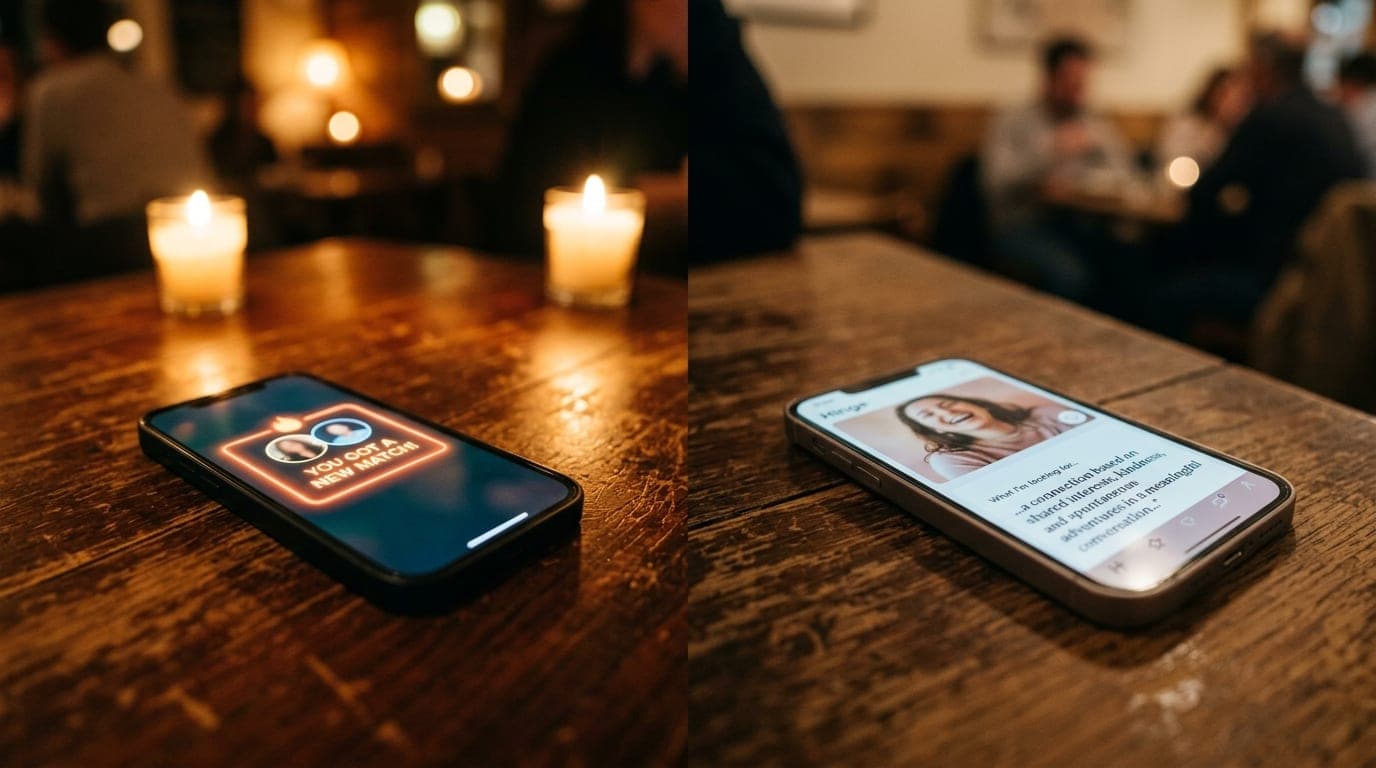
Bumble remains the stronger choice for intentional dating. As of July 2026, its 'Opening Moves' and detailed profiles lead to a response rate nearly double that of Tinder.
As of July 2026, Tinder Platinum is priced at approximately $49 per month in major markets, though prices may vary slightly by region.
While not strictly mandatory to open an account, by July 2026, both apps have made 'Blue Checkmark' verification essentially required for visibility; unverified profiles are rarely shown to other users.
Welcome to the digital meat market. If you’re reading this, you’ve likely spent the last twenty minutes staring at a blurry photo of a guy holding a fish or a girl whose entire personality is "tacos and travel," wondering if there’s a better way to spend your Tuesday night. As of July 2026, the dating app landscape has evolved from a simple "hot or not" game into a sophisticated, AI-driven psychological experiment designed to keep you swiping until your thumb develops carpal tunnel. We’ve moved past the novelty of the swipe; now, we’re navigating an ecosystem of hyper-verification, "Opening Moves," and subscription tiers that cost more than a decent bottle of scotch.
At PillowTalk Daily, we’ve spent the last six months embedded in the trenches of both Tinder and Bumble to give you the cold, hard truth. The short version? Tinder is still the undisputed king of the "right here, right now" connection, while Bumble has pivoted into a curated, slightly more formal garden for those who want a side of conversation with their chemistry. If you want to cut to the chase: download Tinder if you want volume and speed; download Bumble if you’re looking for someone who actually knows how to use a semi-colon and has a LinkedIn profile that isn't terrifying. But let’s go deeper into the digital dirt.
Sponsored Content
Welcome to the digital meat market. If you’re reading this, you’ve likely spent the last twenty minutes staring at a blurry photo of a guy holding a fish or a girl whose entire personality is "tacos and travel," wondering if there’s a better way to spend your Tuesday night. As of April 2026, the dating app landscape has evolved from a simple "hot or not" game into a sophisticated, AI-driven psychological experiment designed to keep you swiping until your thumb develops carpal tunnel. We’ve moved past the novelty of the swipe; now, we’re navigating an ecosystem of hyper-verification, "Opening Moves," and subscription tiers that cost more than a decent bottle of scotch.
At PillowTalk Daily, we’ve spent the last six months embedded in the trenches of both Tinder and Bumble to give you the cold, hard truth. The short version? Tinder is still the undisputed king of the "right here, right now" connection, while Bumble has pivoted into a curated, slightly more formal garden for those who want a side of conversation with their chemistry. If you want to cut to the chase: download Tinder if you want volume and speed; download Bumble if you’re looking for someone who actually knows how to use a semi-colon and has a LinkedIn profile that isn't terrifying. But let’s go deeper into the digital dirt.
User Base & Demographics
Tinder remains the "Big Tent" of the dating world. In July 2026, its user base is a chaotic, beautiful, and sometimes frustrating cross-section of humanity. Because it was the first to the party, it owns the most real estate. You’ll find everyone from the 19-year-old college student looking for a "study buddy" to the 45-year-old divorcee trying to remember how to flirt. The gender ratio on Tinder still tilts heavily toward men—roughly 72/28 in most major urban centers like New York, London, or Sydney. This creates a "fast-food" environment: high volume, low barrier to entry, and a lot of noise. If you’re in a smaller city or traveling, Tinder is your only real option because the sheer density of users ensures you won't run out of profiles after five minutes.
Bumble, on the other hand, is the "Homeowners Association" of dating. The demographics here skew slightly older (24-38) and significantly more "established." We’re talking young professionals, creatives, and people who use words like "intentionality" without irony. The gender ratio is more balanced than Tinder’s, often hovering around 55/45 or 60/40. This is largely because the app’s foundational mechanic—women making the first move—historically filtered out the most aggressive "u up?" energy, attracting a crowd that values a modicum of decorum. However, mid-way through 2026, Bumble has fully leaned into its hybrid model via the "Opening Moves" feature, which has brought in a more traditional crowd, but the vibe remains decidedly more upscale than the Tinder trenches.
Activity levels on Tinder are peak "late night." The app spikes between 9:00 PM and 1:00 AM. It is built for the impulse. Bumble peaks earlier, around 7:00 PM, and sees a massive surge on Sunday afternoons when everyone is nursing a hangover and contemplating their life choices. If Tinder is the club, Bumble is the brunch spot that serves $18 avocado toast.
Features That Actually Matter
The "swipe" is a commodity now, so the real battle is in the supplemental features. In 2026, Tinder has leaned heavily into "Tinder Select," a high-tier membership that promises "VIP" access to the most popular profiles. It’s essentially a digital velvet rope. For the average user, the "Explore" tab is where the action is. Tinder has doubled down on interest-based matching. You can filter for "Thrill Seekers," "Foodies," or "Social Causes," which helps narrow down the 10,000 people within five miles of you. Their AI photo selector is also surprisingly good; it analyzes your library and picks the shots where you look the least like a thumb, which is a godsend for the selfie-challenged.
Bumble’s standout feature in 2026 is "Opening Moves." Realizing that the "women message first" mandate was leading to a lot of "Hey" and "Hi" (or worse, expired matches), Bumble now allows women to set a question that men can respond to first. It’s a hybrid model that keeps the safety of the original design but fixes the "conversation dead-end" problem. Bumble also beats Tinder in the profile department. The prompts are better, the UI is cleaner, and the "Best Bees" feature—an AI-curated daily selection of your most compatible matches—is spookily accurate. While Tinder feels like a slot machine, Bumble feels like a personal assistant who knows you have a weakness for architects who like indie rock.
Both apps now feature "Video Intros" and "Audio Prompts." On Tinder, these are mostly used for "vibe checks" to ensure you haven’t been catfished by someone using photos from 2018. On Bumble, they’re used for "Slow Dating," where users spend more time interacting in-app before actually meeting. If you’re a "get to the point" person, Tinder’s streamlined interface is superior. If you need to know someone’s stance on cilantro and climate change before you share a drink, Bumble’s robust profiles are the winner.
Features That Actually Matter
Ease of Getting Matches
Let’s talk about the "Match Rate" reality check. On Tinder, getting a match is easy; getting a *reply* is the hard part. Because the barrier to swiping right is so low, people do it almost subconsciously. This leads to a massive amount of "Dead Matches"—people who match with you and then never say a word. To succeed on Tinder in 2026, you either need to be in the top 5% of the aesthetic food chain or you need to pay for "Priority Likes." Without a paid tier, your profile is essentially at the bottom of a very large pile. However, if you are looking for a hookup, Tinder is statistically more efficient simply because of the sheer number of active users looking for the same thing.
Bumble is a slower burn. You will likely get fewer matches on Bumble, but the matches you *do* get are significantly more likely to result in a conversation. The "24-hour clock" (where a match expires if a message isn't sent) still exists, and it serves as a powerful motivator. It forces a "use it or lose it" mentality. In 2026, the response rate on Bumble is nearly double that of Tinder. The downside? The "Bumble Burnout." Because the profiles are more detailed and the expectations are higher, the mental energy required to maintain a Bumble conversation is greater. You can’t just send a fire emoji and hope for the best.
In terms of quality, Bumble wins, but in terms of sheer "I want to go on a date tonight," Tinder takes the trophy. If you’re a man, the ease of matches on Bumble has actually improved recently thanks to "Opening Moves," which has reduced the pressure on women to be the sole initiators, leading to more active engagement across the board. If you’re a woman, Tinder will give you an ego boost with the sheer volume of likes, but it will also require a lot more "weeding" to find anyone worth your time.
Pricing & Value
Both apps have become increasingly "Pay-to-Play" as of July 2026. The days of being a "Power User" for free are mostly over. Tinder offers Gold, Platinum, and the aforementioned "Select." Tinder Gold (now roughly $32/month) is the baseline; it lets you see who likes you, which is the only way to navigate the app without losing your mind. Platinum ($49/month) gives you "Priority Likes," which ensures your profile is seen before the "free" plebs. If you’re in a competitive market like LA or NYC, Platinum is almost mandatory if you want to see any real results. Is it worth it? For a month, yes. Long term? It’s a drain.
Bumble Premium and Premium+ are similarly priced, but the value proposition feels slightly higher. Bumble Premium ($38/month) includes "Incognito Mode," which is a game-changer for people who don't want their coworkers or exes seeing them on the app. It also gives you "Unlimited Extends," which is vital for those days when you’re too busy to check the app and don't want a "Great Match" to expire. Bumble’s "Spotlight" (their version of a Boost) is also arguably more effective because the user base is smaller, meaning your profile actually gets seen by a higher percentage of the active pool during that 30-minute window.
The "Value" winner depends on your goal. If you’re a "Power Swiper" who wants to see 500 people a day, Tinder Platinum is the best ROI. If you’re someone who wants to be selective and keep your dating life private, Bumble’s Incognito and filtering tools offer better value for the money. Just be prepared: by mid-2026, both apps have mastered the art of the "micro-transaction." You’ll be tempted to buy "Super Likes" and "Compliments" at every turn. Stay strong. Pick one subscription and stick to it.
Pricing & Value
Safety & Verification
This is the one area where both apps have made massive strides. As of July 2026, "Blue Checkmark" verification is no longer optional for serious users. If you aren't verified, most people will swipe left automatically. Tinder has introduced a robust "ID Verification" system that cross-references your face with your government ID. They’ve also integrated "Share My Date," which allows you to send your date’s location and profile details to a friend with one tap. Tinder’s reporting system has also become more aggressive; they’ve moved toward a "one strike and you’re out" policy for harassment, which has significantly cleaned up the ecosystem.
Bumble, however, is still the gold standard for safety. Their "Deception Detector" (an AI-powered tool introduced in 2024 and perfected by mid-2026) automatically identifies and blocks fake profiles, scams, and bots before they even hit your deck. Bumble also has built-in "Private Detector" technology that blurs unsolicited explicit images, so you don't have to worry about a "surprise" when opening a message. Their "Safety & Wellbeing" center is more comprehensive than Tinder’s, offering resources for everything from digital boundaries to mental health support.
The Verdict: Which Should You Download?
We’ve reached the end of the line, and you want a straight answer. Here it is: The "Best" app is entirely dependent on what you’re looking to do with your Saturday night—and your life.
Download Tinder if: You are looking for hookups, short-term situationships, or you’re traveling and want to meet people fast. Tinder is about volume. It is a numbers game. It is for the person who wants to see everyone and doesn't mind a bit of digital chaos. If you have a great set of photos and a high tolerance for ghosting, Tinder is the most efficient way to get into a bed or onto a barstool with someone new. It is the "Wild West," and for some, that’s exactly where the fun is.
Download Bumble if: You are looking for a relationship, a "quality" date, or you’re feeling burnt out by the low-effort energy of other apps. Bumble is about curation. It attracts people who are willing to put in slightly more effort to fill out a profile and engage in a conversation. It’s for the person who wants to know the "vibe" before the first drink. While the "women message first" rule has evolved, the core audience remains the same: people who want a more respectful, thoughtful dating experience.
The Pro-Tip: Don't use both at the same time. You’ll end up seeing the same people and getting "Swipe Fatigue" within a week. Pick the one that aligns with your current headspace. If you’re in your "Summer of Fun," it’s Tinder. If you’re looking for someone to take to your cousin’s wedding in the fall, it’s Bumble. And for the love of everything holy, get your ID verified and stop using photos of you wearing sunglasses in every shot. We want to see your eyes, not your reflection.
"Tinder is the frantic energy of a 2 AM bar crawl where anything can happen; Bumble is the curated, slightly expensive cocktail lounge where you actually expect to remember the person's name the next morning."